Unpacking Dentures: A Complete Guide to Fulls and Partials
Full Dentures vs Partials: 2025 Confident Smile
Why Understanding Your Denture Options Matters
Full dentures vs partials – this choice affects how you eat, speak, and smile every day. If you’re facing tooth loss, understanding these two main denture types can help you make the right decision for your oral health and quality of life.
Here’s the quick breakdown:
| Full Dentures | Partial Dentures |
|---|---|
| Replace all teeth in upper or lower arch | Replace one or more missing teeth |
| Held by suction and adhesive | Secured with clasps to natural teeth |
| Used when no natural teeth remain | Used when some healthy teeth remain |
| Longer adjustment period (weeks to months) | Shorter adjustment period |
| Generally less expensive | Often more expensive due to customization |
Tooth loss happens to millions of people every year. Whether from gum disease, injury, or age, missing teeth impact far more than just your appearance. They affect your ability to chew properly, speak clearly, and feel confident in social situations.
The good news? Modern dentures can restore both function and aesthetics. But choosing between full and partial dentures isn’t always straightforward. Each option has distinct advantages, costs, and care requirements.
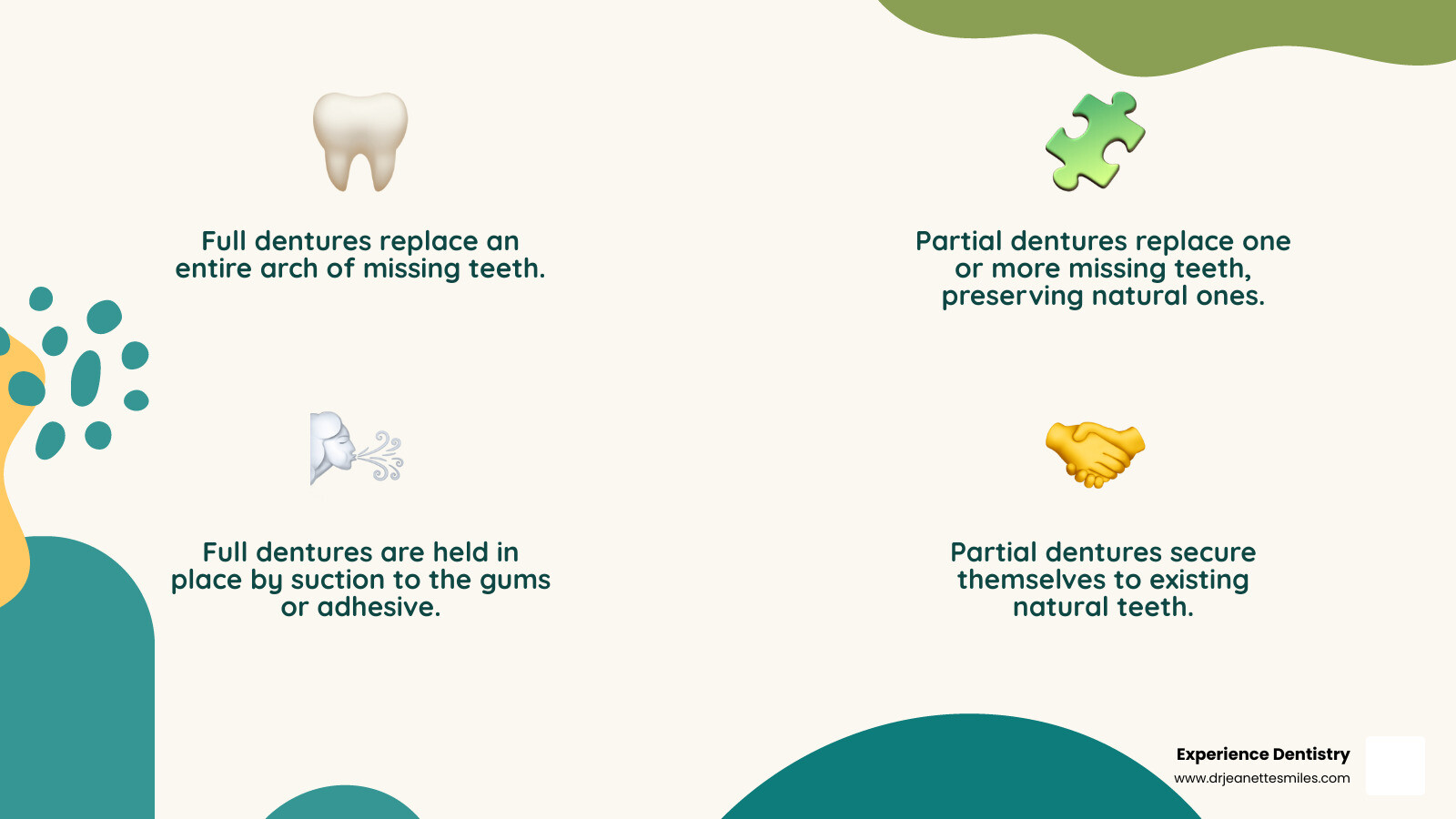
Full dentures replace an entire arch of teeth and rest on your gums. Partial dentures fill gaps between existing healthy teeth, using them for support and stability. The choice depends on how many teeth you’ve lost, the health of your remaining teeth, and your personal preferences.
This guide breaks down everything you need to know about both options. We’ll cover how they work, what to expect during the fitting process, daily care requirements, and costs. By the end, you’ll have the knowledge to discuss your options confidently with your dentist.
What Are Dentures? Understanding the Basics
Think of dentures as your smile’s comeback story. These removable appliances step in when tooth loss threatens to change how you eat, speak, and feel about yourself. Whether you’re missing one tooth or all of them, there’s a denture solution designed specifically for your situation.
The full dentures vs partials decision comes down to one main factor: how many of your natural teeth are still healthy and strong. It’s like choosing between renovating a room or rebuilding the entire house – both approaches work, but they serve different needs.
Full Dentures: A Complete Smile Restoration
When all the teeth in your upper or lower jaw are gone (or need to come out), full dentures become your complete smile makeover. These aren’t just “fake teeth” – they’re carefully crafted appliances that replace everything you’ve lost.
Full dentures consist of two main parts: a gum-colored acrylic base that sits on your gums, and artificial teeth made from durable materials that look remarkably like the real thing. The base is custom-molded to fit your mouth’s unique contours, creating the suction that keeps your dentures in place.
How do they stay put? Upper dentures have an advantage – they can create suction against the roof of your mouth. Lower dentures rely more on your tongue and cheek muscles to stay stable. Many people also use denture adhesive for extra security, especially when eating or speaking.
You have two timing options when getting full dentures:
Conventional dentures are made after your gums have fully healed from any extractions – usually 8 to 12 weeks later. Think of this as the “measure twice, cut once” approach. Your dentist can create a more precise fit because everything has settled into its final position.
Immediate dentures go in right after your tooth extractions, so you never have to go without teeth. While this sounds appealing (and it is!), these dentures will need more adjustments as your gums heal and change shape. They’re often a stepping stone to your final set.
The beauty of modern full dentures is how natural they look and feel. We’re not talking about your grandmother’s teeth in a glass – today’s technology creates dentures that restore both your smile and your confidence.
More info about Full Dentures.
Partial Dentures: Filling the Gaps
If you still have some healthy natural teeth, partial dentures might be your perfect match. These clever appliances fill in the missing pieces of your smile puzzle while keeping your good teeth exactly where they belong.
Here’s what makes partials special: they don’t just replace missing teeth – they actually protect your remaining natural teeth from shifting out of place. When you lose a tooth, the neighboring teeth tend to drift into that empty space, which can mess up your entire bite over time.
Partial dentures have three main components. The replacement teeth look and function like your natural ones. A gum-colored base supports these teeth and blends with your gums. And clasps or precision attachments hook onto your natural teeth for stability – think of them as tiny, gentle hugs that keep everything secure.
The framework materials vary depending on your needs and preferences. Metal clasps are strong and durable, while precision attachments can be more discreet. Your dentist will help you choose what works best for your lifestyle and budget.
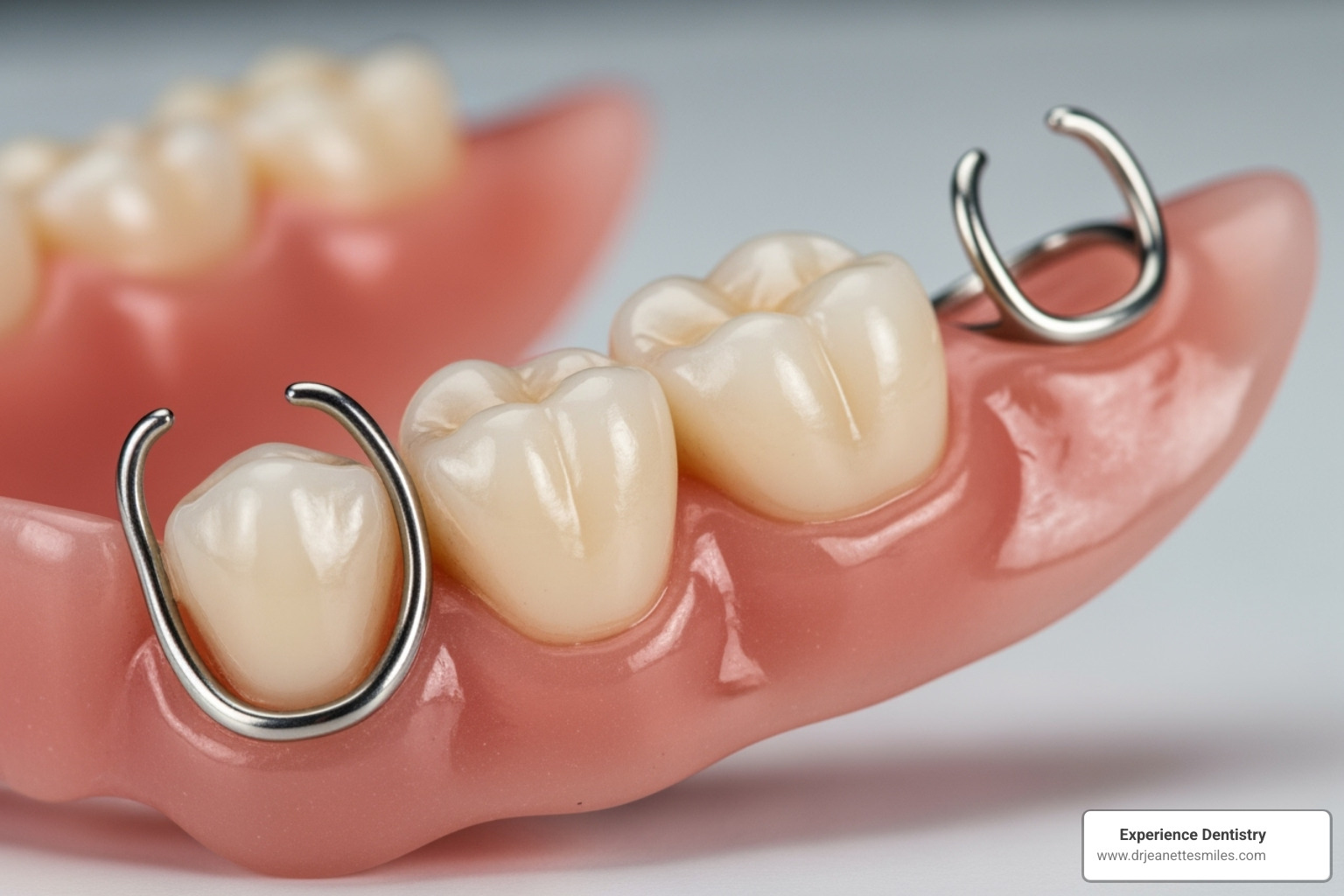
The biggest advantage of partials? You get to keep your healthy teeth while replacing only what you’ve lost. It’s like fixing the broken windows in your house instead of tearing down the whole thing. Plus, partials often feel more stable than full dentures because they anchor to your natural teeth.
Whether you’re missing one tooth or several, partial dentures can restore your ability to chew comfortably and speak clearly – all while keeping your natural smile intact.
More info about Partial Dentures.
The Core Comparison: Full Dentures vs. Partials
Understanding full dentures vs partials becomes much clearer when you see them side by side. Think of it this way: full dentures are like getting a complete makeover for your entire arch, while partial dentures are more like filling in the missing pieces of a puzzle.
| Feature | Full Dentures | Partial Dentures |
|---|---|---|
| Candidates | Individuals missing all teeth in an arch | Individuals missing one or more teeth, with some healthy natural teeth remaining |
| Support Mechanism | Suction to gums and jawbone ridge; may use adhesive | Clasps or precision attachments to natural teeth |
| Impact on Natural Teeth | Requires removal of all remaining teeth in the arch | Preserves natural teeth and prevents shifting |
| Typical Adjustment Period | Weeks to months for speech and eating | Days to weeks; easier adaptation |
The biggest difference? Full dentures start from scratch – they’re for people who have lost all their teeth in an arch and need a complete replacement. Partial dentures work with what you’ve got, filling gaps while keeping your healthy natural teeth right where they belong.
The Fitting and Adaptation Process
Getting new dentures is a journey, and we’re here to guide you through every step. The path looks different depending on whether you’re getting full or partial dentures.
Full dentures often begin with tooth extractions if you still have some teeth that need to come out. Here’s where patience becomes your friend – your mouth needs 8 to 12 weeks to heal properly. During this time, your gums and jawbone reshape themselves, which is completely normal.
Once you’ve healed, we take detailed dental impressions of your mouth. Think of this as creating a blueprint for your new smile. We’ll have several fitting appointments where you can try on wax models and make sure everything looks and feels just right. Want your teeth a little whiter? No problem. Need them shaped differently? We’ve got you covered.
The adjustment period for full dentures can take a few weeks to several months. Don’t worry if you produce more saliva at first or if speaking feels different – this is your mouth’s way of getting used to its new residents. We’ll make adjustments along the way to keep you comfortable.
Partial dentures have their own fitting adventure. Since they need to work around your existing teeth, we take impressions that capture both the gaps and your natural teeth perfectly. The partial is designed with clasps or precision attachments that hook securely onto your healthy teeth.
The good news? Most people adjust to partial dentures much faster than full dentures – often within days or weeks. Your natural teeth provide stability and familiarity, making the transition smoother. You’ll still need some practice with eating and speaking, but it’s usually a gentler learning curve.
Maintenance and Daily Care Requirements
Taking care of your dentures isn’t complicated, but it is important. Whether you choose full dentures vs partials, good daily habits will keep your mouth healthy and your dentures lasting longer.
Daily cleaning is non-negotiable for both types. Remove your dentures after meals to rinse away food particles, and brush them at least twice daily with a soft denture brush and gentle denture cleaner. Regular toothpaste is too harsh – it can scratch the surface and create tiny hiding spots for bacteria.
Removing dentures at night gives your gums the rest they deserve. Soak them in water or denture cleaning solution overnight – never hot water, which can warp them. Even with full dentures, brush your gums, tongue, and the roof of your mouth daily with a soft brush. This keeps your mouth healthy and your circulation flowing.
Partial denture care includes everything above, plus extra attention to your natural teeth. Those clasps can trap food particles, so thorough cleaning around them is essential. Keep flossing your remaining teeth and following good oral hygiene practices – your partial denture’s stability depends on keeping those anchor teeth healthy.
The Denture care guidelines from Cleveland Clinic offer additional tips for maintaining your dentures and oral health.
Lifespan and Cost Considerations for full dentures vs partials
Let’s talk about the practical stuff – how long dentures last and what they cost. These factors often play a big role in decision-making.
Average lifespan for both types is typically 7 to 10 years, though full dentures may need replacement sooner, around 5 to 7 years. Why the difference? Your mouth changes over time. Jawbone naturally shrinks after tooth loss, and gums can recede, affecting fit.
Denture relining every 1 to 2 years helps maintain a snug, comfortable fit as these changes happen. Think of it as a tune-up for your dentures. Skipping this maintenance can lead to sore spots and even accelerate bone loss.
Cost factors vary based on several things. Materials make a difference – higher quality acrylics, porcelain teeth, or metal frameworks for partials cost more but often last longer. Complexity matters too. Intricate designs, precision attachments, or extensive customization to match your natural smile affect pricing. The number of teeth being replaced directly impacts cost.
Generally speaking, full dentures can sometimes cost less upfront than partials, especially if no extractions are needed. However, if multiple extractions are required, the initial investment increases. Partial dentures, while replacing fewer teeth, often cost more due to the custom framework and precise fitting required around existing teeth.
Most dental insurance covers some denture costs, so check with your provider about your specific benefits. At Experience Dentistry, we believe your smile is worth the investment, and we’re happy to help you explore options that fit your budget.
Making Your Decision: Which Denture Is Right for You?
Choosing between full dentures vs partials can feel overwhelming, but you’re not in this alone. This decision is deeply personal and depends on your unique mouth, lifestyle, and what matters most to you. That’s exactly why a professional evaluation with your dentist is so important – we’re here to guide you through every step.
Think of your consultation as a conversation, not an interrogation. We’ll sit down together and explore several key factors that will help determine your best path forward.
The number of missing teeth is usually the starting point. If you’re missing all your teeth in the upper or lower arch (or both), full dentures become the clear choice. But if you still have some healthy natural teeth hanging in there, partial dentures are often the way to go.
The health of your remaining teeth plays a huge role, especially for partials. These teeth need to be strong enough to support your new denture, acting like anchors. If your remaining teeth are wobbly or severely damaged, we might need to explore full dentures or other options instead.
Your jawbone condition is another piece of the puzzle. After losing teeth, your jawbone naturally starts to shrink over time – it’s completely normal, but it affects how well traditional dentures fit. We’ll take X-rays to see what we’re working with and determine if implant support might give you better results.
Let’s talk about budget and insurance too. We know dental care is an investment, and we want to find a solution that works for your wallet as well as your mouth. We’ll review what different options cost and work with your insurance to maximize your benefits.
Your lifestyle needs matter just as much as the clinical factors. Do you love crunchy foods? Are you always chatting with friends? Do you play wind instruments? Some people find partials more stable because of their existing teeth, while others adapt beautifully to full dentures. We want your new teeth to improve your life, not complicate it.
Finally, your overall oral health gives us the complete picture. If you have gum disease or other conditions, we’ll factor those into our recommendations. This is why those regular routine oral exams are so valuable – they help us catch changes early and plan accordingly.

At Experience Dentistry, we believe the right denture should feel like it was made just for you – because it was. We’ll take all the time you need to answer your questions, address your concerns, and help you feel completely confident in your decision. After all, this is about getting your smile back, and that’s worth doing right.
Modern Alternatives and Advanced Denture Technology
While traditional full dentures vs partials work wonderfully for many patients, today’s dental world offers some pretty exciting alternatives. Think of it like upgrading from a reliable car to one with all the latest features – both will get you where you need to go, but the newer options might make the journey more comfortable.
Beyond Traditional Dentures: Implants and Bridges
If you’re looking for something that feels even more like your natural teeth, dental implants might be worth considering. These tiny titanium posts are placed directly into your jawbone, essentially creating new “roots” for replacement teeth. What makes implants special is that they actually help preserve your jawbone – something traditional dentures can’t do.
Here’s where it gets interesting: implants can work together with dentures to give you the best of both worlds. Implant-supported dentures snap securely onto a few strategically placed implants, dramatically reducing the slipping and sliding that sometimes happens with traditional dentures. You can still remove them for cleaning, but they stay put when you’re eating or laughing with friends.
For an even more permanent solution, implant-retained dentures are fixed in place and feel incredibly natural. You brush and care for them just like regular teeth, right in your mouth. The catch? They typically cost more and require oral surgery, so they’re not right for everyone.
More about Implant Restorations.
Dental bridges offer another fixed option if you’re missing just one or a few teeth in a row. Think of a bridge as exactly what it sounds like – it “bridges” the gap using your healthy neighboring teeth as anchors. The artificial teeth are permanently cemented in place, giving you a stable bite and natural appearance.
The trade-off with bridges is that your adjacent teeth need to be prepared (shaped) to support the restoration. It’s a bit like remodeling – you get great results, but there’s no going back to the original structure.
Learn about dental crowns and bridges.
How Technology Is Improving the Denture Experience
Remember those old movies where dentures would slip out at the worst possible moment? Those days are long gone, thanks to some pretty amazing technological advances.
3D scanning has revolutionized how we take impressions. Instead of those gooey molds that made you feel like you couldn’t breathe, we can now create incredibly precise digital impressions using advanced scanners. The result? Dentures that fit accurately and comfortably right from the start.
The materials we use today are light-years ahead of what was available even a decade ago. Modern acrylics, resins, and porcelain create artificial teeth that look remarkably natural. They capture the subtle translucency and color variations of real teeth, so your new smile blends seamlessly with your facial features.
For partial dentures, precision attachments have largely replaced those obvious metal clasps. These nearly invisible connectors provide excellent security while maintaining a natural appearance. No more worrying about people noticing your dental work when you smile.
Computer-aided design allows us to create dentures with unprecedented precision. Every curve and contour is digitally mapped and milled to exact specifications. This means better fit, improved comfort, and more predictable results.
The bottom line? Whether you choose full dentures vs partials, today’s technology ensures you’ll get a comfortable, functional, and beautiful result. We’re excited to offer these innovations to help make your denture experience as positive as possible.
At Experience Dentistry, we stay current with these advances because we believe you deserve the best options available. During your consultation, we’ll discuss which technologies and treatments make the most sense for your unique situation and goals.
Frequently Asked Questions about Full Dentures vs. Partials
We know that choosing between full dentures vs partials brings up lots of questions. You’re not alone in wondering about the practical day-to-day aspects of living with dentures! Here are the answers to the most common concerns we hear from patients just like you.
Can I sleep with my dentures in?
This is probably our most frequently asked question, and we totally understand why you’d wonder! While it might feel more secure to keep your dentures in all the time, we strongly recommend removing them at night.
Think of it this way – your gums work hard all day supporting your dentures, and they deserve a good night’s rest too. Your gum tissues need to breathe and recover from the constant pressure. Without this break, you’re much more likely to develop sore spots, irritation, or even infections.
Removing your dentures overnight also reduces bacteria buildup. Your mouth naturally produces less saliva while you sleep, which means bacteria can party all night long if given the chance. Taking out your dentures disrupts this bacterial bash and keeps your mouth healthier.
Plus, nighttime is the perfect opportunity for overnight soaking and cleaning. Your dentures get a thorough cleaning while your gums get their beauty sleep – it’s a win-win situation!
Will dentures affect how I eat and speak?
Let’s be honest – yes, there will be an initial adjustment period when you first get your dentures. But here’s the good news: this is completely normal and temporary!
When it comes to eating, we always tell our patients to start with soft foods and be patient with themselves. Cut your food into smaller pieces than usual, and chew on both sides of your mouth to keep your dentures stable. Avoid anything super sticky, crunchy, or piping hot for the first few weeks. Your mouth is learning a new skill, so give it time to master the technique.
Speaking might feel a bit awkward at first too. You might notice a slight lisp or feel like your tongue is doing gymnastics to form certain words. The secret? Practice speaking aloud as much as possible! Read your favorite book out loud, chat with your pet, or sing in the shower. The more you practice, the faster you’ll sound like yourself again.
Most of our patients tell us that any discomfort or awkwardness subsides within a few weeks. Millions of people wear dentures and eat, speak, and laugh confidently every day. You’ll get there too!
Are full dentures more comfortable than partials?
This is a great question, but the honest answer is that comfort is really personal – what feels great to one person might not work for another when comparing full dentures vs partials.
Partial dentures often feel more stable right from the start because they hook onto your existing natural teeth. It’s like having built-in anchors that keep everything in place. Many patients love this added security, especially when eating or speaking.
Full dentures cover more area in your mouth, including the roof of your mouth if you’re getting upper dentures. Some people need time to adjust to this feeling, while others find the coverage provides a sense of security and completeness.
Here’s what really matters: a custom, precise fit is the most important factor for comfort in both types of dentures. When your dentures fit properly, they distribute pressure evenly and feel like a natural part of your mouth. That’s why we take such care during your fitting appointments and make adjustments until everything feels just right.
At Experience Dentistry, we’re committed to making sure your dentures feel as comfortable as possible. If something doesn’t feel right, we want to know about it so we can fix it!
Conclusion: Restore Your Smile with Confidence
Choosing between full dentures vs partials doesn’t have to feel like navigating uncharted waters. Throughout this guide, we’ve walked through the key differences, fitting processes, care requirements, and costs to help you understand your options clearly.
Here’s what it comes down to: full dentures are your go-to solution when you’re missing all teeth in an arch, offering complete smile restoration through suction and adhesive. Partial dentures shine when you have healthy natural teeth remaining, filling gaps while preserving what you already have. Both options have come a long way thanks to modern technology, providing comfort and natural aesthetics that would have seemed impossible just a decade ago.
The right choice depends entirely on your specific dental needs. Your number of missing teeth, the health of remaining teeth, jawbone condition, budget, and lifestyle all play important roles in this decision. That’s exactly why a professional consultation is essential – and frankly, non-negotiable.
At Experience Dentistry, we believe your dental experience should be anything but ordinary. We’ll play your favorite songs while we work, explain everything in plain English, and create a personalized plan that fits your unique situation. No boring dental jargon, no rushing through appointments – just honest guidance to help you make the best choice for your smile.
Your missing teeth don’t define you, and they certainly shouldn’t hold you back from laughing freely, enjoying your favorite foods, or feeling confident in conversations. Whether you need full dentures, partials, or want to explore modern alternatives like implant-supported options, we’re here to guide you every step of the way.
Ready to take that first step toward your new smile? We’d love to meet you and discuss how we can help restore your confidence.
Learn more about your denture options and schedule a consultation today!