Implants vs. Dentures A Head-to-Head Battle for Your Best Smile
Dentures vs Implants: Ultimate Smile 2025
Why Your Smile Deserves the Right Choice
Facing tooth loss, the dentures vs implants decision can be overwhelming. Both restore your smile but work in very different ways.
Quick Answer for Dentures vs Implants:
| Factor | Dentures | Implants |
|---|---|---|
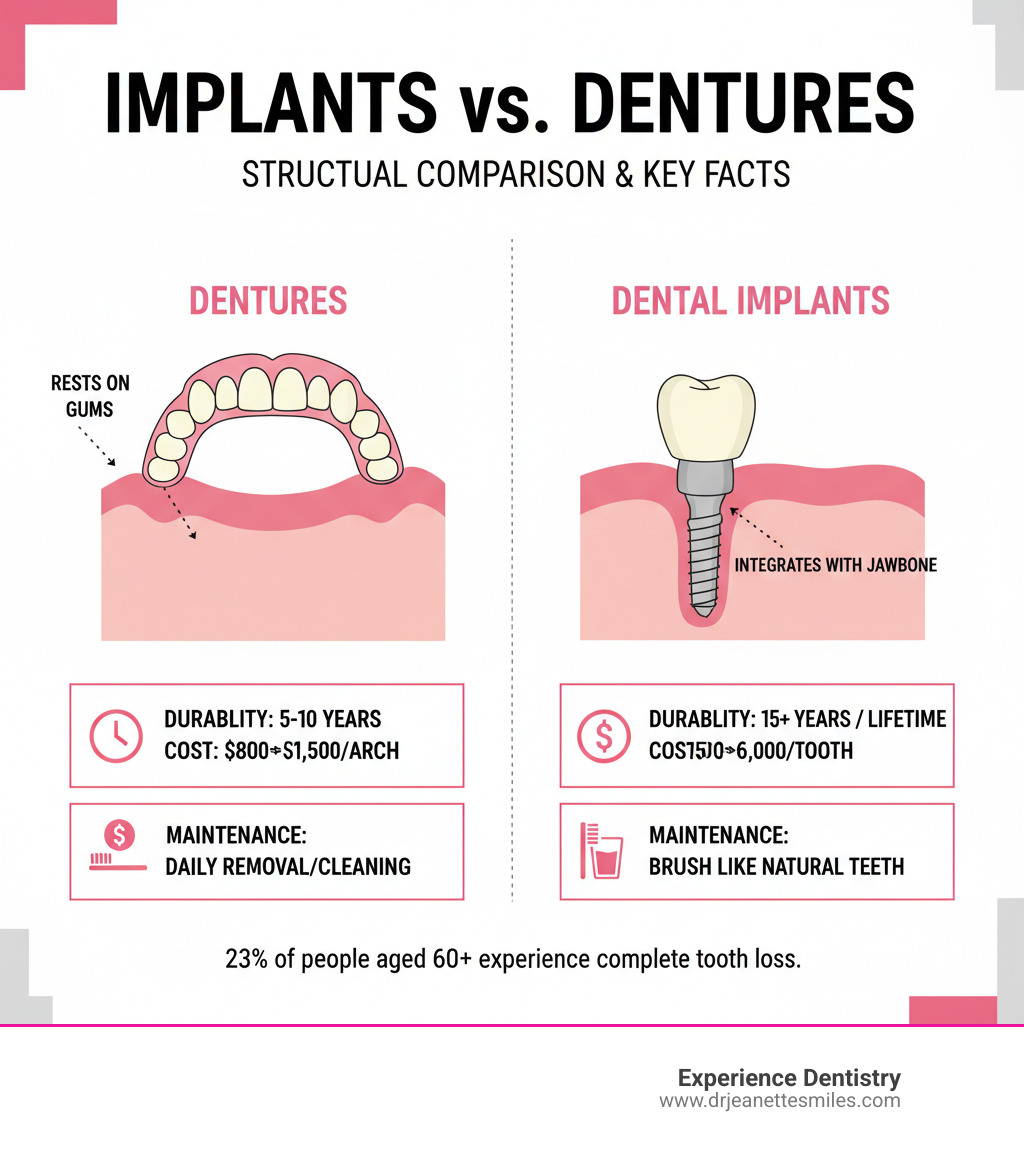
| Cost | $800-$1,500 per arch | $1,500-$6,000 per tooth |
| Durability | 5-10 years | 15+ years to lifetime |
| Surgery | No surgery needed | Requires surgery |
| Bone Health | No bone stimulation | Prevents bone loss |
| Maintenance | Daily removal/cleaning | Brush like natural teeth |
With about 23% of people aged 60 and above experiencing complete tooth loss, tooth replacement is a common dental need. The solution you choose will impact your daily life for years.
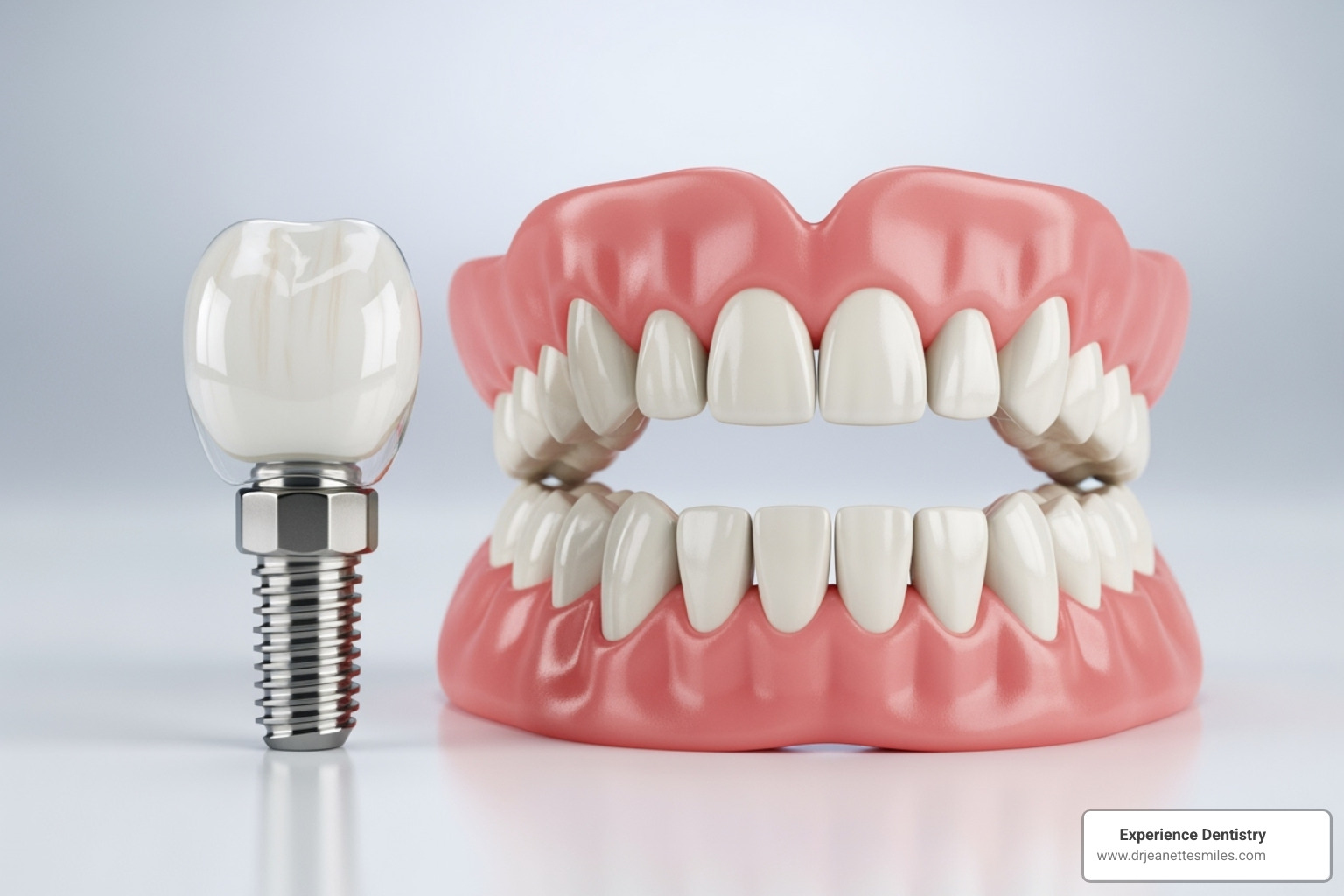
Dentures are removable appliances that sit on your gums, a solution that has helped millions for decades. Dental implants are titanium posts surgically placed in your jawbone, acting as artificial tooth roots.
This guide covers costs, procedures, and maintenance to help you understand which solution is best for your unique situation. The right choice depends on your health, lifestyle, budget, and preferences. There’s no single best answer, but there is a best answer for you.
What Are Dentures and Dental Implants?
Understanding how each tooth replacement option works will help you make the best choice for your smile.
Traditional Dentures: The Removable Solution
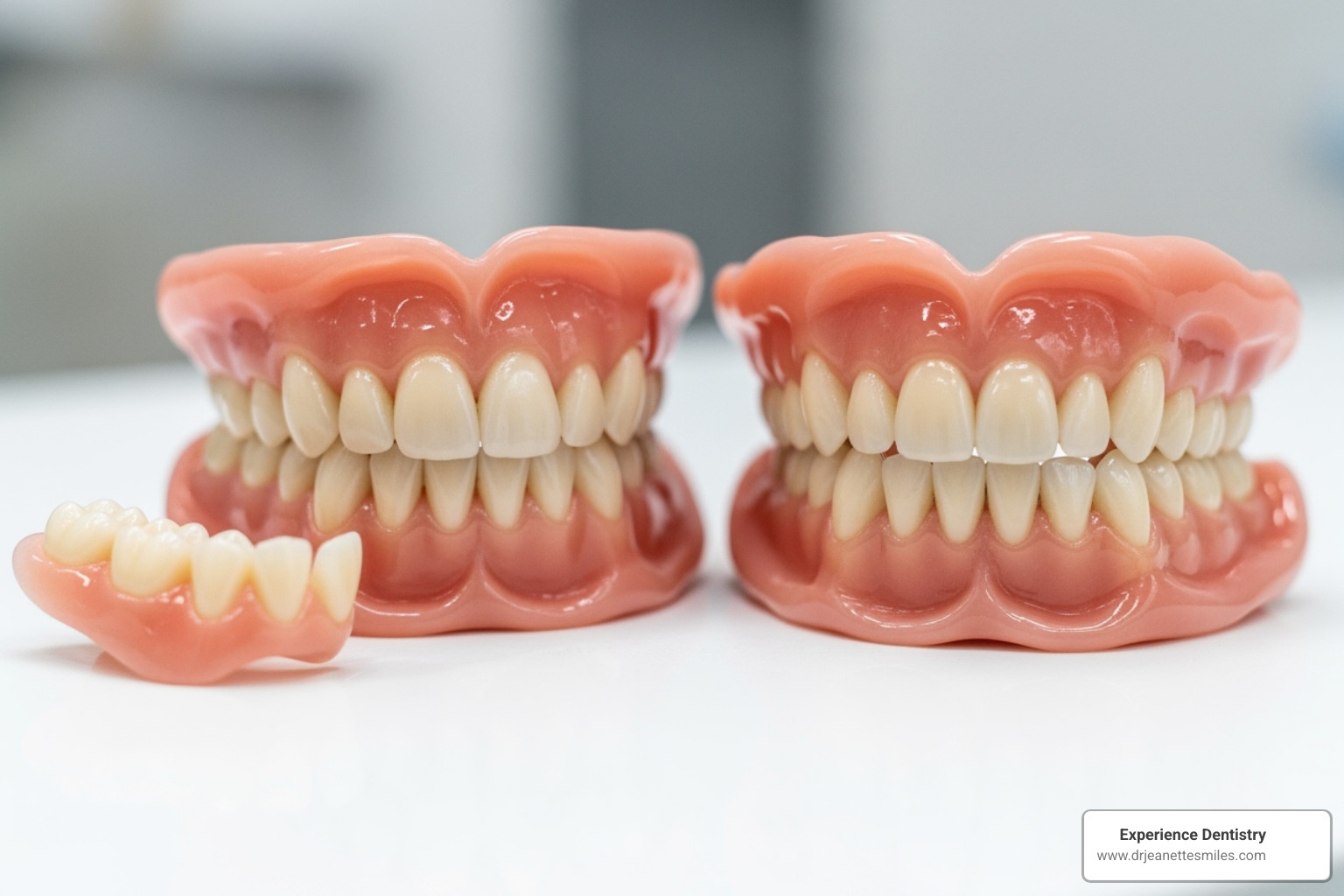
Dentures are a trusted, time-tested solution. These removable prosthetics have an acrylic base colored to match your gums, with real-looking artificial teeth. They sit on your gums, held in place by suction, though many people use dental adhesives for extra security. A key difference in the dentures vs implants debate is flexibility. Full dentures replace an entire arch, while partial dentures fill gaps if you have healthy natural teeth remaining. Dentures are a straightforward, non-invasive approach, fitted quickly to restore your ability to eat, speak, and smile. You can learn more about your options with our Full Dentures and Partial Dentures services.
Dental Implants: The Permanent Foundation
Dental implants are essentially artificial tooth roots. Unlike dentures, they become part of your jawbone. A small, biocompatible titanium post is surgically placed into the jawbone. Over several months, a process called osseointegration occurs, where your bone fuses with the post, creating a strong, stable foundation. Once healed, a connector called an abutment is attached, followed by a custom crown. The result looks, feels, and functions like a natural tooth. What makes implants special in the dentures vs implants comparison is how they mimic natural teeth by integrating with your body. Our Implant Restorations can help you explore if this permanent solution is right for you.
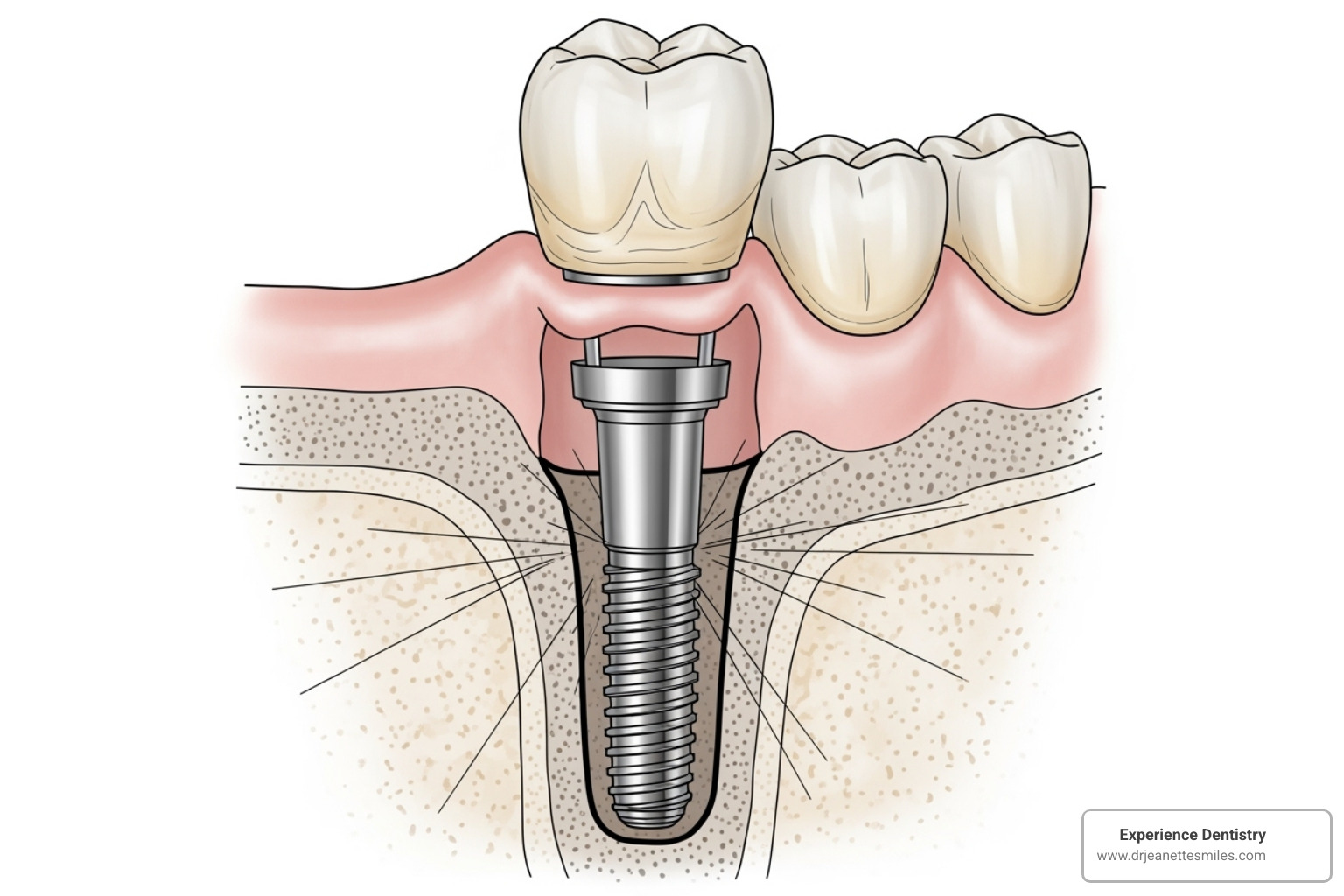
The Ultimate Comparison: Dentures vs Implants
So, how do dentures vs implants stack up? Let’s break down the key differences that will help shape your decision.
| Factor | Traditional Dentures | Dental Implants |
|---|---|---|
| Durability | Typically 5-10 years before needing replacement or relining | 15-25 years or even a lifetime with proper care |
| Comfort | Can feel bulky, may slip, cause sore spots, require adhesives | Feels like natural teeth, very stable and comfortable |
| Function | Restores chewing, but often with limitations; can affect speech | Restores nearly 98% of natural chewing power; no speech impediment |
| Bone Health | Does not stimulate jawbone, can lead to bone loss over time | Stimulates jawbone, preventing bone loss and preserving facial structure |
| Aesthetics | Can look natural, but may not blend perfectly; can appear bulky | Highly natural appearance, blends seamlessly with existing teeth |
| Maintenance | Daily removal, cleaning, soaking; periodic relining/adjustments | Brush and floss like natural teeth; regular dental check-ups |
Durability and Long-Term Outlook
Regarding longevity, dentures vs implants are very different. Traditional dentures typically last 5-10 years. As your jawbone shrinks over time, dentures loosen, requiring relining or replacement. In contrast, dental implants can last 15-25 years or even a lifetime with proper care. The titanium post integrates with your jawbone, providing incredible stability. While the crown may need replacing after 10-15 years, the foundation is solid, often making implants more cost-effective long-term.
Functionality, Comfort, and Aesthetics
Your choice will affect daily life. Traditional dentures restore much of your ability to eat and talk, but they can slip with certain foods, which can affect speech. They may feel bulky initially, but most people adjust. Dental implants excel here. Anchored in your jawbone, they are stable, allowing you to eat anything and speak naturally. Aesthetically, while modern dentures look good, implants often have an edge, emerging from the gums just like natural teeth. Implants also maintain your facial structure, preventing the “sunken” look and boosting self-confidence.
Impact on Oral Health and Bone Density
From a health perspective, the difference is significant. Your jawbone needs stimulation from tooth roots to stay healthy; without it, the bone shrinks (a process called resorption). Traditional dentures sit on the gums and can’t provide this stimulation; ill-fitting ones can even accelerate bone loss. Dental implants solve this. Acting like natural tooth roots, they stimulate the jawbone, preventing bone loss. This preservation is a huge long-term health benefit unique to implants. Implants are also independent and don’t affect healthy adjacent teeth. Regardless of your choice, excellent oral hygiene is essential.
The Journey and The Cost: Procedure, Recovery, and Investment
Let’s discuss the time and money involved. The path to your new smile differs for dentures vs implants.
The Procedure and Recovery Timeline
The Denture Journey is straightforward. We take detailed impressions to craft perfectly fitting dentures, and several fittings ensure comfort and proper bite alignment. No surgery is required. You may experience minor sore spots initially, which we can easily adjust.
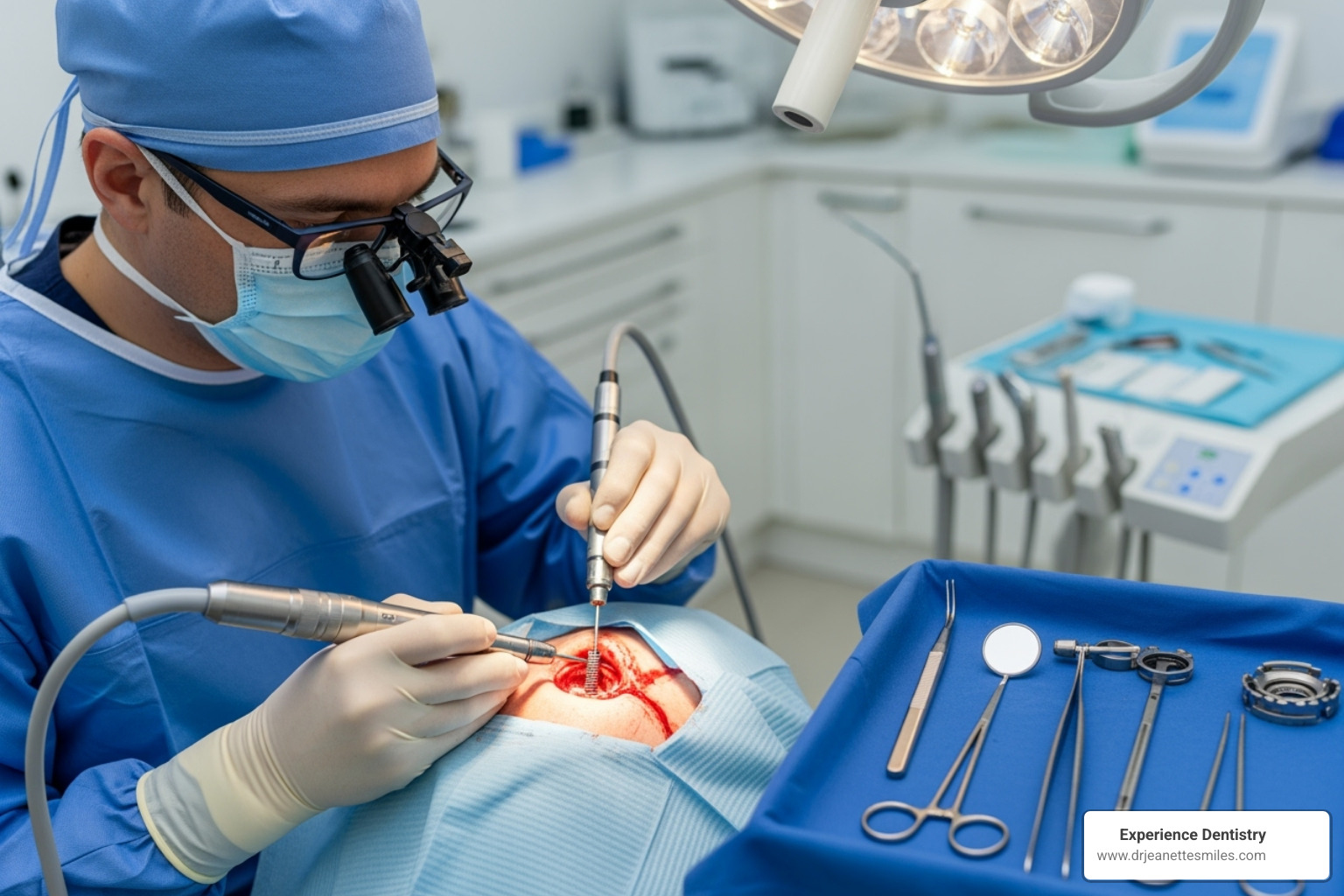
The Implant Adventure requires more patience. After a consultation to ensure your jawbone is ready (sometimes requiring bone grafting), the implant placement is done under local anesthesia. Then, osseointegration takes 3 to 6 months as your jawbone fuses with the implant. Once complete, we attach the abutment and your new crown. It’s a longer journey, but the result can last for decades.
Daily Maintenance and Care
Your daily routine will change depending on your choice.
Living with dentures requires a nightly ritual of removing, brushing, and soaking them. During the day, dental adhesives can provide extra security.
Caring for implants is simpler: just brush and floss them like natural teeth. No removal or special solutions are needed. For both options, regular dental check-ups are important to maintain your investment.
The Financial Breakdown: Dentures vs Implants
Understanding the true cost of dentures vs implants goes beyond the initial price.
Dentures are the budget-friendly option, with complete sets from $800 to $1,500 per arch and partials from $700 to $1,800. Premium versions can cost more.
Implants require a bigger initial investment, with a single implant and crown ranging from $1,500 to $6,000, per ADA cost data. A full mouth can start around $40,000.
However, the long-term math tells a different story. Dentures need replacing or relining every 5-10 years, and these costs add up. Implants, often lasting a lifetime, can be more economical over time.
Insurance coverage is often more generous for dentures, but implant coverage is improving. We can help you steer your insurance options.
Beyond the Basics: Hybrids and Alternatives
The dentures vs implants decision isn’t always either-or. The best solution might combine elements of both or be a different alternative altogether.
Implant-Supported Dentures: The Best of Both Worlds?
Implant-supported dentures offer the stability of implants without the cost of replacing every tooth. This hybrid is a denture that “snaps” onto a few strategically placed dental implants. These overdentures are stabilized by implants in your jawbone, not just suction. The result is significantly less slippage when eating or speaking, allowing you to enjoy more foods with confidence.
One popular approach is the All-on-4 concept, which uses just four implants per arch to support a full set of teeth. It’s helpful for those with some bone loss who want a fixed solution without extensive bone grafting. Removable versions snap on and off for easy cleaning, while fixed options are only removed by your dentist. This flexibility allows for a solution that fits your lifestyle. The cost is between traditional dentures and full implants, providing excellent function and stability for a lower price than a full set of individual implants.
What About Dental Bridges?
Dental bridges are another alternative. As fixed partial dentures, they are permanently cemented in place. A dental bridge literally bridges the gap from missing teeth, consisting of artificial teeth (pontics) held by crowns on the adjacent natural teeth or implants (abutment teeth). The abutment teeth must be reshaped for the crowns.
The main advantage is that it’s completely fixed and feels stable. You care for it like your natural teeth. Bridges can be an excellent choice for patients who want a permanent option but aren’t candidates for implants. However, bridges require altering healthy adjacent teeth to serve as anchors. You can learn more about What do Dental Crowns and Bridges Do? to understand the process.
Implants are often preferred as they don’t alter healthy teeth and they preserve jawbone. However, if you’re not a surgical candidate or prefer a non-surgical fixed option, a bridge might be perfect. We have more information about dental bridges if you’d like to explore this option further.
Frequently Asked Questions about Dentures vs Implants
Choosing between dentures vs implants brings up many questions. Here are answers to the most common ones.
Who is a good candidate for each option?
There’s no universal “best” choice. The right option depends on your individual situation, including these factors:
- Bone density is crucial for implants. If significant bone loss has occurred, we might discuss bone grafting or alternatives.
- Overall health is important for implant surgery. Conditions like uncontrolled diabetes can affect healing, requiring careful planning. Dentures are a non-surgical option for those with complex health issues.
- Age is less of a factor than health. However, younger patients may need to wait until their jaw is fully developed.
- Budget is a key factor. Dentures have a lower upfront cost, but implants can be more cost-effective long-term.
- Lifestyle is important. Implants restore full chewing power, while dentures may require some dietary adjustments.
- Hygiene commitment is crucial. Implants require care like natural teeth, while dentures need nightly removal and cleaning.
Dentures are a good choice for a quick, non-surgical, budget-friendly solution, or if significant bone loss or health concerns make surgery risky.
Implants are preferred for a natural feel, jawbone preservation, and long-term stability, if you are comfortable with the surgical process and higher upfront cost.
How many teeth can be replaced?
Both solutions are flexible in replacing any number of teeth.
- For a single missing tooth, a dental implant is often recommended. It replaces the tooth without affecting adjacent teeth and provides a natural feel.
- For several missing teeth, a partial denture can fill the gaps. Alternatively, an implant-supported bridge offers a fixed solution.
- For a full arch, traditional full dentures are an option. Implants can also restore a complete arch with solutions like the All-on-4 system or snap-on implant-supported dentures.
Is the process painful?
Pain is a common concern, and we are committed to your comfort throughout the process.
Getting dentures is generally comfortable. You might have some temporary tender spots as your mouth adjusts, which we can fix in follow-up appointments. Most people adapt within a few weeks.
Implant surgery is performed under local anesthesia, so you won’t feel pain during the procedure. We also offer sedation options and can play your favorite music to help you relax. After surgery, some soreness and swelling are normal. Discomfort is manageable with pain relievers and our detailed post-op instructions. Healing is often smoother than expected, and following instructions is key to a proper recovery.
Conclusion: Choosing Your Path to a Confident Smile
After exploring every angle of the dentures vs implants decision, you might be feeling like you’ve just completed a dental school crash course! But here’s what matters most: both options can genuinely transform your life and restore your confidence to smile, eat, and speak without worry.
Let’s bring it all together. Dentures offer a time-tested, non-invasive solution that can quickly get you back to enjoying meals with family and laughing without covering your mouth. They’re more budget-friendly upfront and don’t require surgery. However, they need daily removal and cleaning, may limit some food choices, and don’t provide the jawbone stimulation that prevents long-term bone loss.
Dental implants represent the closest thing to getting your natural teeth back. They’re permanently fixed in your mouth, let you eat anything you want, and actually help preserve your facial structure by preventing bone loss. The trade-offs? They require surgery, take longer to complete, and involve a higher initial investment.
The truth is, there’s no one-size-fits-all answer in the dentures vs implants debate. Your best choice depends on factors that are uniquely yours – your health, your jawbone condition, your lifestyle, your budget, and what you value most in a tooth replacement solution. Maybe you prioritize the permanence of implants, or perhaps the removability of dentures fits better with your routine.
Some patients love the security of knowing their teeth are permanently anchored. Others appreciate being able to remove their dentures for thorough cleaning. Some prioritize the bone health benefits of implants, while others focus on minimizing upfront costs. The long-term value equation looks different for everyone based on their individual circumstances.
That’s exactly why a professional consultation is so important. At Experience Dentistry, we don’t believe in cookie-cutter solutions. We take the time to really understand your unique situation, listen to your concerns and priorities, and thoroughly evaluate your oral health. We’ll walk you through all your options – including hybrid solutions like implant-supported dentures – and help you make the decision that’s right for you.
Our personalized approach means we’re not just looking at your mouth; we’re considering your whole life. Do you love crunchy foods? Are you nervous about surgery? Is budget a primary concern? Do you want the most natural feel possible? We factor in all of these elements to guide you toward the solution that will make you happiest in the long run.
Ready to take the next step toward your confident smile? We’re here to make your dental experience anything but boring – we’ll even play your favorite songs during your visit! Learn more about your options from partial vs. full dentures or reach out today to schedule your personalized consultation. Let’s work together to find the perfect solution for your unique smile.